
Hanover County Assault and Battery Lawyer
 Riley & Wells Attorneys-At-Law represents clients charged with assault and battery, domestic assault, malicious wounding, unlawful wounding, and related violent offenses in Hanover County, Virginia. Under Virginia Code §§ 18.2-57, 18.2-57.2, and 18.2-51, these allegations may involve misdemeanor or felony charges depending on the conduct, alleged injuries, relationship between the parties, criminal intent, and other statutory requirements. Our Hanover County assault and battery lawyers examine witness statements, surveillance recordings, police reports, medical evidence, self-defense claims, and conflicting accounts of the incident. We represent clients in Hanover County General District Court, Juvenile and Domestic Relations District Court, and Circuit Court, evaluating the Commonwealth’s evidence, potential defenses, and consequences of the charges.







Hanover County Assault and Battery Defense Guide
Hanover County Defense Services
For broader statewide guidance, see our Virginia Assault and Battery Lawyer page.
Assault and Battery Under Virginia Law
 Virginia Code § 18.2-57 provides that simple assault and assault and battery are generally Class 1 misdemeanors. These offenses can arise from arguments, fights, workplace confrontations, disputes between acquaintances, and other incidents involving alleged threats or physical contact. More serious charges may apply when the Commonwealth alleges aggravated conduct, particular victim classifications, or circumstances supporting a felony offense. Our Hanover County assault and battery lawyers represent clients accused of misdemeanor assault, domestic assault, malicious wounding, unlawful wounding, and related criminal offenses. We review the charging documents, witness accounts, video recordings, physical evidence, alleged injuries, and statements to determine what the Commonwealth must prove and whether legal defenses may apply. The fact that someone was injured, made an accusation, or contacted law enforcement does not independently establish that the accused committed a criminal offense. The circumstances surrounding the incident and the elements of the particular charge must be evaluated.
What Is Assault in Virginia?
An assault does not necessarily require physical contact. Under Virginia common law, an assault may involve an attempt to commit a battery or conduct intended to place another person in reasonable apprehension of immediate bodily harm when the accused has the apparent ability to carry out the threatened contact.
The Commonwealth may attempt to prove an assault through statements, gestures, threatening movements, witness testimony, video recordings, or other evidence concerning the alleged confrontation.
Whether the accused actually intended to threaten or harm another person, and what the other person reasonably perceived, may become important issues.
What Is Battery in Virginia?
Battery generally involves a willful or unlawful touching of another person without legal justification or excuse.
An injury is not necessarily required. Even relatively slight physical contact may constitute a battery when the touching is unlawful and occurs in a rude, angry, or insulting manner.
However, not every touching is criminal. Accidental contact, incidental contact, consent, self-defense, and other circumstances may affect whether the Commonwealth can establish the offense.
The distinction between an intentional unlawful touching and an accident can be important in Hanover assault and battery prosecutions.
Does an Assault and Battery Charge Require an Injury?
No. An assault may occur without physical contact, and a battery does not necessarily require visible injury.
A Hanover assault case may depend primarily on what witnesses say occurred rather than medical evidence.
When injuries are alleged, photographs, medical records, witness observations, and the timing of the injuries may be important.
The defense should examine whether the physical evidence supports the accusation, contradicts it, or fails to establish who initiated the confrontation.
Hanover County Domestic Violence Lawyer
 Domestic assault and battery is addressed by Virginia Code § 18.2-57.2. The statute makes it a criminal offense to commit an assault and battery against a qualifying family or household member. Hanover County domestic violence allegations may arise from disputes between spouses, former spouses, relatives, parents, individuals who share a child, people who live together, former cohabitants, or other persons who qualify under Virginia law. These cases can involve allegations of pushing, grabbing, hitting, unwanted physical contact, or other conduct during a domestic confrontation. Domestic assault cases often involve conflicting accounts of an incident that occurred without independent witnesses. Responding Hanover County Sheriff’s deputies may interview the parties, document injuries, photograph the scene, obtain statements, and attempt to determine who initiated or escalated the encounter. An arrest does not establish guilt. The Commonwealth must prove the underlying assault and battery and the qualifying family or household relationship required by the statute.
Who Qualifies as a Family or Household Member?
Virginia Code § 16.1-228 defines family or household member for purposes of domestic assault proceedings.
Depending on the circumstances, the definition includes:
- Current and former spouses
- Parents, children, stepparents, stepchildren, siblings, grandparents, and grandchildren
- Certain other relatives who reside in the same household
- Individuals who have a child together
- Individuals who currently cohabit or cohabited within the previous 12 months
- Certain children residing with qualifying cohabitants
- Legal custodians of juveniles
- Qualifying intimate partners
Virginia law also defines qualifying intimate partners to include certain recent romantic, dating, or sexual relationships.
Whether the relationship falls within the statutory definition can be a significant legal issue. The Commonwealth must prove the qualifying relationship as well as the underlying criminal offense.
Domestic Assault Penalties and Repeat Offenses
A first domestic assault and battery offense under § 18.2-57.2 is generally a Class 1 misdemeanor.
A conviction may result in up to 12 months in jail, a fine of up to $2,500, or both.
Prior qualifying convictions can increase the seriousness of a later domestic assault charge.
Under § 18.2-57.2, a person with two qualifying prior convictions for specified offenses against family or household members may face a Class 6 felony when the statutory requirements are satisfied. The prior offenses must satisfy the statute’s different-date and 20-year requirements.
Domestic assault allegations may also affect employment, professional licensing, security clearances, firearm rights, family relationships, and housing arrangements.
First-Offense Domestic Assault Deferred Disposition
Virginia Code § 18.2-57.3 provides a deferred-disposition procedure for certain eligible defendants charged with a first qualifying domestic assault offense.
The statute may permit the court to defer proceedings without entering a finding of guilt and place the defendant on probation subject to statutory conditions.
Eligibility depends on several requirements, including the defendant’s criminal history, previous participation in the procedure, the evidence or plea before the court, consent to the deferral, and other statutory considerations.
Conditions may involve probation, education or treatment programs, compliance with court orders, and other requirements.
When a defendant successfully completes the statutory conditions, the proceeding may be discharged and dismissed without an adjudication of guilt.
A deferred disposition is not automatically available or appropriate in every case. The available evidence, potential defenses, and consequences of accepting the arrangement should be evaluated before deciding how to proceed.
Can the Alleged Victim Drop a Domestic Assault Charge?
Once a criminal charge is brought, the alleged victim does not independently control whether the prosecution continues.
The Commonwealth’s Attorney prosecutes criminal offenses on behalf of the Commonwealth, and dismissal or other disposition is subject to the applicable legal process and court authority.
The alleged victim’s position may still be relevant. Prosecutors may consider witness cooperation, credibility, prior statements, independent evidence, photographs, recordings, and the circumstances surrounding the allegation.
A request by the alleged victim to withdraw the charge does not automatically require dismissal.
A defendant should not attempt to influence or contact a witness in violation of a protective order, bond condition, or other legal restriction.
Emergency Protective Orders and No-Contact Restrictions
A Hanover County domestic assault allegation may result in an emergency protective order under Virginia Code § 16.1-253.4.
When a warrant for assault and battery against a family or household member under § 18.2-57.2 is issued, the magistrate is generally required to issue an emergency protective order as authorized by the statute, subject to the statutory exception involving a minor defendant.
An emergency protective order may restrict contact, prohibit certain conduct, or exclude a person from a shared residence.
Under current Virginia law, an emergency protective order ordinarily expires at 11:59 p.m. on the third day following issuance. If the expiration falls on a day when the court is not in session, the order extends until 11:59 p.m. on the next day the Juvenile and Domestic Relations District Court is in session.
Additional proceedings may involve preliminary protective orders or protective orders entered following a hearing.
The criminal prosecution and protective-order proceedings are legally distinct, even when they arise from the same incident.
A protective order may affect communication, physical proximity, residence arrangements, and other aspects of daily life. The exact language of the order controls the restrictions imposed.
An alleged violation can result in separate legal consequences or criminal charges.
Our attorneys evaluate protective orders and related proceedings when preparing a defense to Hanover domestic assault allegations.
Hanover County Malicious and Unlawful Wounding Lawyer
Malicious wounding and unlawful wounding are felony offenses under Virginia Code § 18.2-51.
These charges may arise from fights, domestic confrontations, workplace altercations, shootings, stabbings, or other incidents involving bodily injury.
The statute is not limited to injuries caused by firearms or knives. It applies to prohibited conduct causing bodily injury by any means when the required criminal intent and mental state are established.
A Hanover County malicious wounding prosecution may involve disputed allegations concerning intent, malice, self-defense, witness credibility, medical evidence, and the circumstances surrounding the injury.
The existence of an injury does not automatically establish malicious or unlawful wounding. The Commonwealth must prove the particular statutory elements beyond a reasonable doubt.
Malicious Wounding Under Virginia Code § 18.2-51
Malicious wounding involves maliciously shooting, stabbing, cutting, wounding, or otherwise causing bodily injury to another person with the intent to maim, disfigure, disable, or kill.
The Commonwealth must establish the required bodily injury, specific intent, and malice.
Malice may be established through the circumstances surrounding the alleged conduct, including statements, threats, the nature of the confrontation, the manner in which an injury occurred, and other evidence.
Malicious wounding is a Class 3 felony.
Unlawful Wounding Under Virginia Law
Unlawful wounding also falls under § 18.2-51.
When the prohibited act is committed unlawfully but without malice, while the required intent to maim, disfigure, disable, or kill remains present, the offense may constitute unlawful wounding.
Unlawful wounding is a Class 6 felony.
The distinction between malicious and unlawful wounding is important because the potential penalties differ significantly.
However, unlawful wounding should not be confused with ordinary assault and battery. Both malicious and unlawful wounding require the specific intent established by § 18.2-51.
Malice, Specific Intent and Heat of Passion
The Commonwealth must prove more than the existence of an injury to establish malicious or unlawful wounding.
Both offenses require proof of an intent to maim, disfigure, disable, or kill. Malicious wounding additionally requires proof of malice.
Relevant evidence may include:
- Statements or threats before the confrontation
- Who initiated or escalated the incident
- The manner in which the injury allegedly occurred
- The nature and location of the injuries
- Whether a weapon was involved
- The number and nature of alleged blows
- Witness testimony and video recordings
- Evidence concerning provocation or heat of passion
- The accused person’s conduct before and after the incident
Evidence of legally sufficient provocation and heat of passion may become important when determining whether conduct was malicious or occurred without malice.
A separate question is whether the Commonwealth can establish the specific intent required for either felony wounding offense.
Depending on the evidence, the defense may challenge the existence of malice, the required intent, identity, causation, or other elements of the charge.
Aggravated Malicious Wounding
Virginia Code § 18.2-51.2 establishes the separate offense of aggravated malicious wounding.
This offense generally requires malicious wounding conduct with the necessary specific intent and proof that the victim was severely injured and suffered permanent and significant physical impairment.
Aggravated malicious wounding is a Class 2 felony.
Medical records, photographs, surgical records, treatment history, expert opinions, and evidence concerning the permanence and significance of an alleged impairment may be important.
Because the additional injury requirements substantially increase the seriousness of the offense, each statutory element should be examined carefully.
Can a Fight Result in a Malicious Wounding Charge?
Yes. A confrontation involving punches, kicks, or other physical force may result in a felony wounding charge when the Commonwealth alleges the required injury, intent, and mental state.
The presence of a firearm, knife, or other weapon is not necessary in every prosecution.
However, a fight that results in an injury does not automatically establish malicious wounding.
The defense may examine how the confrontation began, whether the accused acted in self-defense, whether the Commonwealth can prove the required specific intent, and whether the evidence supports a felony offense rather than a lesser assault charge.
Penalties for Assault, Domestic Assault and Wounding in Virginia
The potential punishment depends on the exact offense charged, the elements established, prior qualifying convictions, and any applicable statutory enhancements.
Misdemeanor Assault and Battery
Simple assault and assault and battery under Virginia Code § 18.2-57 are generally Class 1 misdemeanors.
A Class 1 misdemeanor is punishable by up to 12 months in jail, a fine of up to $2,500, or both.
Different provisions and enhanced penalties may apply when the alleged victim falls within particular protected classifications or other statutory circumstances are established.
Domestic Assault and Battery
Assault and battery against a family or household member under § 18.2-57.2 is ordinarily a Class 1 misdemeanor.
Certain repeat domestic assault offenses may be prosecuted as Class 6 felonies when the statutory prior-conviction requirements are met.
Felony Wounding Penalties
- Unlawful wounding: Class 6 felony, generally punishable by one to five years in prison, with statutory discretion for alternative misdemeanor-range punishment.
- Malicious wounding: Class 3 felony, punishable by five to 20 years in prison and a possible fine of up to $100,000.
- Aggravated malicious wounding: Class 2 felony, punishable by imprisonment for life or a term of at least 20 years and a possible fine of up to $100,000.
The charge classification, sentencing exposure, and additional statutory consequences should be evaluated based on the exact offense and facts of the case.
Consequences Beyond Jail and Fines
Assault-related convictions may have consequences beyond the sentence imposed by the court.
Depending on the conviction and circumstances, potential consequences may affect:
- Employment and job applications
- Professional licensing
- Security clearances
- Educational opportunities
- Criminal background checks
- Firearm rights
- Immigration status
- Housing and residence arrangements
- Future criminal proceedings
- Family relationships
Felony convictions and qualifying domestic violence convictions can create particularly significant firearm-related consequences under state or federal law.
The defense should consider both the immediate criminal penalties and the possible long-term consequences of a conviction or proposed disposition.
Self-Defense in Hanover County Assault and Battery Cases
 Self-defense can be an important issue in Hanover County assault and battery prosecutions, including cases involving domestic disputes and felony wounding allegations. Virginia recognizes the right to use legally justified force in response to certain threats of imminent physical harm. Whether self-defense applies depends on the facts, including how the confrontation began, whether the accused reasonably perceived an imminent threat, the degree of force used, and the conduct of the individuals involved. A person who is without fault in provoking or initiating a confrontation may, under applicable Virginia law, defend against an imminent unlawful attack without a general duty to retreat. Different rules may apply when the accused initially provoked the confrontation or engaged in mutual combat. The force used must be legally justified and proportionate to the circumstances. Deadly force and nondeadly force involve different considerations. A self-defense claim should be evaluated using the full sequence of events rather than assuming that the person who struck first, suffered the most visible injury, or contacted law enforcement first was necessarily justified.
Who Started the Confrontation?
One important issue may be who initiated or escalated the encounter.
Assault allegations frequently arise from rapidly developing arguments in which the participants provide conflicting descriptions of what occurred.
The defense may examine statements, injuries to both parties, video evidence, witness accounts, prior communications, and conduct immediately before and after the incident.
An accusation that the defendant initiated a confrontation does not eliminate the need to review the complete evidence.
Mutual Combat and Provocation
Some assault cases involve allegations that both individuals voluntarily participated in a fight.
Mutual combat, provocation, withdrawal, and escalation can affect the availability of a self-defense claim under Virginia law.
The legal analysis may depend on whether the accused was initially at fault, whether the accused withdrew from the encounter when legally required, and whether the force used was justified in response to the threat.
A claim that both individuals were fighting does not automatically establish a defense.
Defense of Others
Some Hanover assault cases arise when a person uses force while attempting to protect a child, spouse, family member, friend, or another individual.
Whether defense of others applies depends on the perceived threat, the surrounding circumstances, and whether the use of force was legally justified.
Witness accounts, video recordings, injuries, and communications may help establish why the accused intervened and what occurred.
Hanover County Assault Investigations and Evidence
Assault investigations may involve the Hanover County Sheriff’s Office, Ashland Police Department, Virginia State Police, or another law-enforcement agency with jurisdiction over the alleged incident.
Responding officers may interview the people involved, identify witnesses, photograph injuries, document property damage, obtain statements, and prepare criminal complaints or investigative reports.
The Commonwealth may rely on testimony from the alleged victim, witnesses, responding officers, medical professionals, or other persons with knowledge of the incident.
Evidence may include:
- Police body-camera recordings
- Surveillance and cellphone video
- 911 calls and dispatch recordings
- Photographs of injuries
- Medical and treatment records
- Witness statements
- Statements attributed to the accused
- Text messages and emails
- Social-media communications
- Photographs of the incident location
- Evidence of property damage
- Weapons or other physical evidence
- Prior communications between the parties
- Evidence concerning injuries to the accused
The evidence should be examined as a whole.
A photograph may document an injury without establishing how it occurred. A witness may have observed only part of a confrontation. A short video clip may omit important events immediately before or after the alleged assault.
Evidence that appears unfavorable when viewed in isolation may have a different significance when the complete circumstances are considered.
Conflicting Witness Accounts and Credibility
Many assault prosecutions depend on competing accounts of the same incident.
The defense may evaluate whether witnesses had an opportunity to observe what occurred, whether their statements changed over time, and whether their accounts are consistent with physical evidence or recordings.
Relationships between witnesses, prior interactions, inconsistencies, and other circumstances may affect credibility.
The prosecution must prove the charge beyond a reasonable doubt, even when the allegations involve only two participants and no independent witnesses.
Accidental Contact and Lack of Criminal Intent
Not every physical contact constitutes criminal battery.
Incidental touching, accidental contact, or conduct lacking the required unlawful intent may present different legal issues from an intentional battery.
The circumstances leading to the contact and the accused person’s conduct may be important when determining whether the elements of the charged offense can be established.
Search, Seizure and Statements to Police
Some assault investigations involve searches of residences, vehicles, personal belongings, electronic devices, or other property.
The Fourth Amendment protects against unreasonable governmental searches and seizures. Depending on the circumstances, questions may arise concerning consent, warrants, probable cause, or exceptions to the warrant requirement.
Statements made during police encounters may also raise Fifth Amendment, Miranda, voluntariness, or other evidentiary issues.
Our attorneys review the circumstances surrounding police questioning and evidence collection to determine whether legal challenges may be available.
Possible Outcomes and Mitigation
Assault cases may be resolved through trial, dismissal, acquittal, negotiated disposition, or other procedures permitted by Virginia law.
Some cases present factual or legal defenses that may support dismissal or acquittal. Others may involve negotiations concerning a lesser offense, punishment, counseling, restitution, community service, good behavior, or other lawful conditions.
Potential mitigation may include the defendant’s prior record, employment, education, relevant treatment, circumstances surrounding the incident, and other factors.
The available evidence and legal defenses should be examined before deciding whether litigation, negotiation, or mitigation is appropriate.
Hanover County Courts for Assault and Domestic Violence Charges
 Assault and battery cases arising in Hanover County may proceed through General District Court, Juvenile and Domestic Relations District Court, or Circuit Court depending on the charge and procedural stage. Adult misdemeanor assault and battery charges under § 18.2-57 are ordinarily heard in Hanover General District Court. Domestic assault and battery cases involving qualifying family or household members under § 18.2-57.2 are generally heard in Hanover Juvenile and Domestic Relations District Court. Related family-abuse protective-order proceedings may also be handled in that court. Malicious wounding, unlawful wounding, and aggravated malicious wounding are felony offenses. These charges may involve district-court proceedings, preliminary hearings, grand jury consideration, and prosecution in Hanover Circuit Court. The particular court and procedural path should be confirmed from the charging documents and court notices.
Hanover County General District Court
Hanover General District Court
7530 County Complex Road
Hanover, Virginia 23069
Adult misdemeanor assault and battery cases ordinarily proceed through General District Court.
Depending on the charge, the case may involve an arraignment or advisement, pretrial proceedings, motions, negotiations, and trial.
The Commonwealth must prove the elements of the charged offense beyond a reasonable doubt.
Hanover Juvenile and Domestic Relations District Court
Hanover Juvenile and Domestic Relations District Court
7530 County Complex Road
Hanover, Virginia 23069
Domestic assault and battery charges involving family or household members are generally prosecuted in Juvenile and Domestic Relations District Court.
The court also handles qualifying juvenile matters and family-abuse protective-order proceedings.
An accused person may have separate criminal and protective-order hearing dates arising from the same alleged incident.
The defendant should carefully review all court notices, protective orders, and bond conditions.
Hanover County Circuit Court
Hanover Circuit Court
7530 County Complex Road
Hanover, Virginia 23069
Felony malicious wounding and unlawful wounding cases that proceed beyond the district-court stage are generally handled in Hanover Circuit Court.
Circuit Court proceedings may involve indictments, pretrial motions, plea negotiations, jury or bench trials, and sentencing.
Appeals from qualifying district-court criminal dispositions may also proceed to Circuit Court under Virginia law.
What Happens After an Assault Arrest or Summons?
The exact procedural steps depend on the charge and the court.
A Hanover assault case may involve:
- Police investigation
- Criminal summons or arrest warrant
- Magistrate appearance
- Bond or release conditions
- Emergency protective order
- Arraignment or advisement
- Discovery and evidence review
- Pretrial motions
- Negotiations or other proceedings
- Preliminary hearing in qualifying felony cases
- Trial or other disposition
- Sentencing or appeal
Not every case involves every stage.
Our attorneys review the summons, warrant, indictment, protective order, and other available paperwork to identify the exact charge, court, hearing date, and immediate requirements.
Assault and Battery Defense Throughout Hanover County Communities
Our attorneys represent clients charged with assault and battery, domestic assault, malicious wounding, unlawful wounding, and related offenses throughout Hanover County.
Hanover includes the incorporated Town of Ashland and numerous residential, commercial, suburban, and rural communities.
Communities served by our attorneys include:
- Ashland
- Atlee
- Beaverdam
- Cold Harbor
- Doswell
- Elmont
- Hanover Courthouse
- Mechanicsville
- Montpelier
- Old Church
- Rockville
- Shady Grove
- South Anna
- Studley
Assault allegations may arise from domestic disputes, workplace confrontations, encounters between acquaintances, arguments at businesses, neighborhood disputes, or other incidents occurring throughout these communities.
Cases arising in residential neighborhoods in Mechanicsville, Atlee, Ashland, and surrounding areas may involve different factual circumstances from allegations occurring at workplaces, commercial properties, or public locations elsewhere in Hanover County.
Domestic assault cases may involve protective-order proceedings, family relationships, competing accounts, and questions concerning the accused person’s use of force. Other cases may involve confrontations between unrelated individuals, alleged injuries, or felony wounding accusations.
Regardless of where the incident occurred within the county, the defense should focus on the precise charge, court jurisdiction, evidence, applicable law, and circumstances of the confrontation.
Hanover County Assault and Battery Case Result
Hanover County Assault and Battery — Dismissed
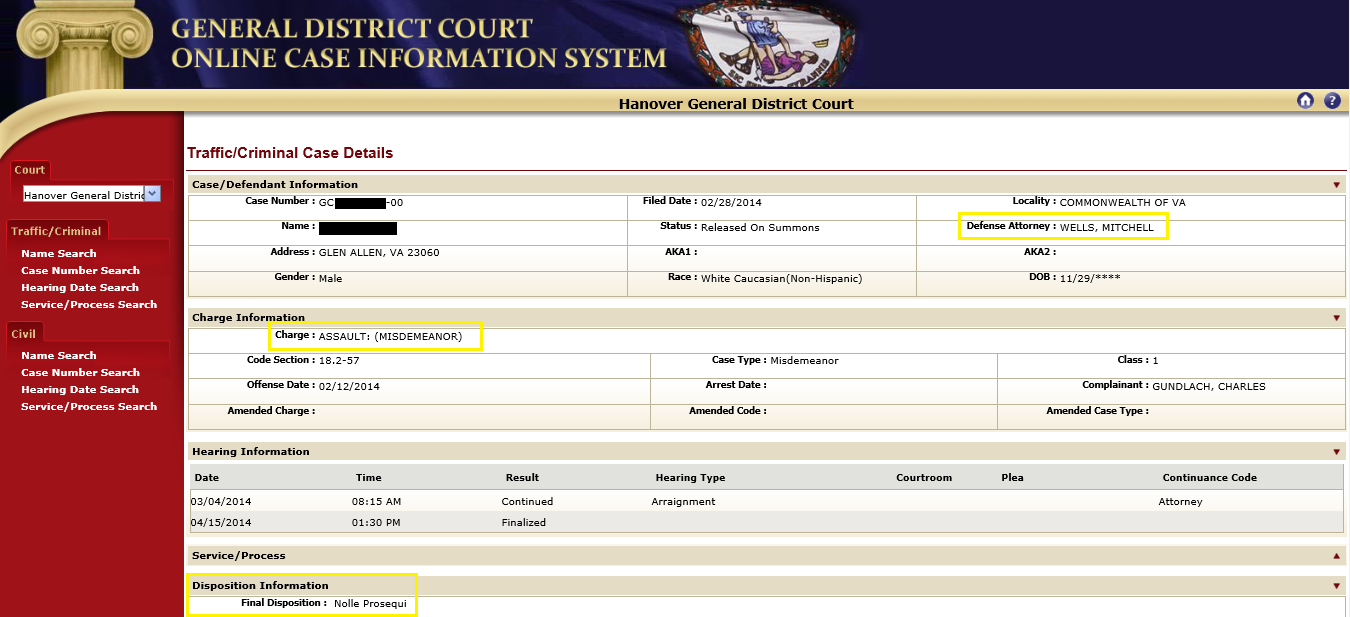
Hanover County Assault & Battery Dismissed
Our attorneys represented a client charged with assault and battery following an altercation at a motor vehicle dealership in Hanover County. The client was a dealership manager who had been involved in a confrontation with a customer previously banned from the business. The customer made an accusation that resulted in our client’s arrest. The incident had been recorded by dealership surveillance cameras. Our attorneys obtained and examined the available recordings and other evidence concerning the confrontation. After reviewing the evidence and presenting the circumstances to the prosecution, our attorneys secured a dismissal of the assault and battery charge. This result illustrates the importance of obtaining and preserving surveillance evidence in assault and battery cases. Every case depends on its particular facts, evidence, and applicable law.
What to Send for a Hanover Assault and Battery Case Review
Providing the basic charging documents and available evidence can help our attorneys identify immediate issues concerning the charge, court date, bond conditions, protective orders, and potentially relevant defenses.
Helpful materials may include:
- Criminal summons or arrest warrant
- Court date and location
- Bond or release paperwork
- Emergency or preliminary protective orders
- Photographs of alleged injuries
- Photographs of the incident location
- Surveillance or cellphone recordings
- Relevant text messages or emails
- Witness names and contact information
- Medical records already available
- Documents concerning prior interactions
- Statements attributed to the accused
- Information about 911 calls or recordings
- Other paperwork from police or the court
Potentially relevant evidence should be preserved in its original form.
Do not delete, alter, or edit photographs, video recordings, messages, electronic communications, or other materials that may relate to the incident.
You do not need every document before contacting our office. The charge, court date, and available paperwork are useful starting points.
Hanover County Assault and Battery Lawyer Client Review

Frequently Asked Questions About Hanover County Assault Charges
What is the difference between assault and battery in Virginia?
Under Virginia law, assault and battery are related but distinct concepts. An assault may involve an attempted battery or conduct intended to place another person in reasonable apprehension of immediate bodily harm. Battery generally involves unlawful physical contact. An assault does not always require touching, and battery does not necessarily require a visible injury.
Is assault and battery a misdemeanor in Hanover County?
Simple assault and assault and battery under Virginia Code § 18.2-57 are generally Class 1 misdemeanors, punishable by up to 12 months in jail, a fine of up to $2,500, or both. Different penalties or felony charges may apply when the statutory requirements for enhanced or more serious offenses are satisfied.
Can self-defense apply to an assault and battery charge?
Yes. Self-defense may apply when the accused used legally justified force in response to an imminent unlawful threat. The analysis depends on who initiated or escalated the confrontation, the threat reasonably perceived, the degree of force used, and other circumstances. Witness accounts, injuries, video recordings, and physical evidence may be important.
What is domestic assault and battery in Virginia?
Virginia Code § 18.2-57.2 makes it a criminal offense to commit assault and battery against a qualifying family or household member. A first offense is generally a Class 1 misdemeanor. The Commonwealth must prove the underlying assault and battery and the qualifying relationship under Virginia law.
Can a first domestic assault charge receive a deferred disposition?
Virginia Code § 18.2-57.3 permits deferred proceedings for certain eligible defendants charged with a first qualifying domestic assault offense. The court must determine whether the statutory requirements are satisfied. Successful completion of the required conditions may result in dismissal without an adjudication of guilt. Eligibility and the appropriateness of this procedure depend on the circumstances.
Can the alleged victim drop a domestic assault charge?
The alleged victim does not independently control whether a criminal prosecution continues. The Commonwealth’s Attorney prosecutes criminal offenses, and dismissal or other disposition involves the applicable legal process and court authority. The alleged victim’s wishes may be considered, but a request to withdraw the charge does not automatically require dismissal.
Does a domestic assault charge result in a protective order?
When a warrant is issued for assault and battery against a family or household member under § 18.2-57.2, the magistrate is generally required to issue an emergency protective order under the applicable statutory provisions, subject to the exception involving a minor defendant. Additional protective-order proceedings may also occur. The terms of any order must be followed unless modified or dissolved by the court.
What is the difference between malicious wounding and unlawful wounding?
Both offenses are addressed by Virginia Code § 18.2-51 and require proof of bodily injury and the specific intent to maim, disfigure, disable, or kill. Malicious wounding additionally requires proof of malice and is a Class 3 felony. Unlawful wounding involves the prohibited act committed unlawfully but without malice and is a Class 6 felony.
Does malicious wounding require a weapon?
No. Virginia Code § 18.2-51 includes shooting, stabbing, cutting, wounding, or causing bodily injury by any means when the required intent and mental state are established. A malicious or unlawful wounding allegation can arise from an incident involving punches, kicks, blunt objects, or other physical force. The Commonwealth must still prove the statutory elements.
Where are assault and domestic violence charges heard in Hanover County?
Adult misdemeanor assault and battery charges are generally heard in Hanover General District Court. Domestic assault charges involving qualifying family or household members are generally handled in Hanover Juvenile and Domestic Relations District Court. Felony malicious or unlawful wounding charges may involve district-court proceedings before prosecution in Hanover Circuit Court. The principal Hanover courts are located at 7530 County Complex Road, Hanover, Virginia 23069.
Request a Hanover County Assault and Battery Case Review
If you have been charged with assault and battery, domestic assault, malicious wounding, unlawful wounding, or a related offense in Hanover County, reviewing the available evidence and exact statutory charge is an important first step. Our attorneys represent clients facing misdemeanor and felony assault-related allegations in Hanover County. We examine witness statements, surveillance recordings, injuries, medical evidence, police reports, statements to law enforcement, self-defense issues, protective orders, and other circumstances that may affect the prosecution or defense. Contact our lawyers for a confidential Hanover County assault and battery case review. Include the court date, exact charge, and a copy or photograph of the available charging paperwork.
10/30/2013 | Updated 10/31/2026