
Charlottesville VA Traffic Lawyer | 1500+ Reviews
 Riley & Wells Attorneys-At-Law represents drivers charged with traffic violations in Charlottesville, Virginia. Cases may involve a traffic summons, misdemeanor traffic charge, suspended license allegation, failure to obey a highway sign, improper passing, following too closely, failure to yield or another violation heard in Charlottesville General District Court. Our attorneys review the exact charge, officer observations, driving record, witness statements, body camera recordings, dashboard camera recordings and other available evidence. We also advise clients about court procedure, possible DMV consequences, appearance requirements and defense options. A traffic summons is not a conviction. Each Charlottesville traffic case should be evaluated according to its individual facts, evidence, driving history and possible consequences before the scheduled court date.







Charlottesville Traffic Defense Guide
| Defense Services | Traffic Violations |
| Uniform Summons | Types of Charges |
| License Charges | Moving Violations |
| Evidence Review | DMV Consequences |
| Court Process | Frequently Asked Questions |
Charlottesville Defense Services
- Charlottesville Criminal and Traffic Defense
- Charlottesville Reckless Driving Lawyer
- Charlottesville Speeding Ticket Lawyer
- Charlottesville DUI and DWI Lawyer
- Charlottesville Criminal Defense Lawyer
For broader statewide guidance, see our Virginia Traffic Lawyer page.
Charlottesville Traffic Violations
 Traffic cases in Charlottesville may involve an ordinary infraction, misdemeanor traffic charge, felony allegation, license offense or another violation arising from the operation of a motor vehicle. The exact charge, Virginia Code section, officer observations, driving record and available evidence should be reviewed before deciding whether to prepay the summons, appear in court or contest the allegation. An ordinary traffic summons is not a conviction, and the Commonwealth must prove the charged violation through admissible evidence.
Charlottesville traffic cases may involve:
- Driving on a suspended or revoked license
- Driving without a valid license
- Driving after forfeiture under § 18.2-272
- Failure to obey a highway sign
- Failure to yield
- Following too closely
- Improper passing
- Unsafe lane changes
- Stop sign and red light violations
- Move over violations
- Handheld device violations
- Aggressive driving
- Eluding law enforcement
- Leaving the scene or failing to report an incident
- Insurance and registration violations
- Equipment and other traffic violations
Virginia Uniform Summons
 A Virginia Uniform Summons is frequently issued during a traffic stop. Although drivers commonly refer to the document as a ticket or citation, it is the formal notice identifying the charge and scheduled court proceeding. Signing the summons is generally not an admission of guilt. It usually confirms receipt of the document and the obligation to appear or otherwise respond as required. Some ordinary traffic infractions may be eligible for prepayment. Prepayment ordinarily results in a conviction for the charge printed on the summons and should not be confused with dismissal.
The summons should be reviewed for:
- The exact charge and Virginia Code section
- The alleged date, time and location
- The issuing officer and law enforcement agency
- The assigned court
- The hearing date and time
- Whether another charge was also issued
- Whether the document contains prepayment instructions
- Whether personal appearance may be required
Traffic Infractions and Criminal Traffic Charges
Virginia traffic law includes infractions, misdemeanors and felony offenses. The classification matters because the potential consequences and court procedures differ.
An ordinary traffic infraction may result in a fine, court costs, DMV demerit points and a conviction on the driving record. A criminal traffic charge may also expose the accused person to jail, probation, license suspension and a criminal conviction record.
The exact charge should be confirmed before deciding how to respond. A document commonly described as a traffic ticket may charge:
- An ordinary moving violation
- A nonmoving traffic violation
- A license or registration offense
- A Class 1 misdemeanor
- Another misdemeanor traffic offense
- A felony traffic allegation
- Multiple charges arising from the same stop
- A charge requiring personal appearance
Charlottesville has separate pages for speeding tickets, reckless driving and DUI or DWI because those allegations involve distinct statutes, evidence and potential consequences.
Suspended, Revoked and Unlicensed Driving Charges
License related cases may involve an allegation that the person drove while the license or privilege to drive was suspended, revoked, forfeited or otherwise invalid.
The defense should review more than the status appearing on a driving record. Relevant issues may include:
- The exact license status on the alleged date
- The reason for the suspension or revocation
- Whether the accused person had legal notice
- Whether the person was operating a motor vehicle
- Whether a restricted license was in effect
- Whether the driving was permitted by the restriction
- The accuracy of DMV records
- Whether the charge is supported by the correct statute
- Whether prior convictions affect the classification or punishment
Driving after forfeiture under § 18.2-272 is a separate criminal allegation that may arise when a person is accused of driving after a qualifying DUI related suspension, revocation or restriction. The court order, restricted license, DMV record and alleged reason for driving should be reviewed carefully.
Other Moving Violations
Moving violations may involve the driver’s position on the roadway, response to traffic control devices, interaction with other vehicles or compliance with duties imposed by Virginia traffic law.
Common allegations include:
- Failure to obey a highway sign
- Failure to stop at a stop sign
- Failure to obey a red traffic signal
- Failure to yield the right of way
- Following another vehicle too closely
- Improper passing
- Unsafe or improper lane changes
- Failure to use a required signal
- Improper turning
- Failure to maintain a lane
- Move over violations
- Handheld device violations
- Failure to wear a required restraint
- Other traffic control violations
The defense may involve the location and visibility of signs, traffic signal sequence, pavement markings, surrounding vehicles, officer viewpoint, roadway design and available video evidence.
Serious Charlottesville Traffic Charges
Some traffic allegations are criminal rather than ordinary infractions. The seriousness of the charge depends on the statute, alleged conduct, prior record and surrounding circumstances.
Criminal traffic cases may include:
- Driving on a suspended or revoked license
- Driving after forfeiture of driving privileges
- Aggressive driving
- Eluding law enforcement
- Leaving the scene of a driving incident
- Operating a vehicle without a valid license under circumstances creating criminal liability
- Other misdemeanor or felony traffic allegations
The charging document should be reviewed to determine whether the offense is an infraction, misdemeanor or felony and whether incarceration, license suspension or another criminal consequence is authorized.
Traffic Evidence and Defense Review
 A traffic defense should begin with the exact statutory elements and the evidence the Commonwealth may rely upon. The contents of the summons alone do not prove the alleged violation. The review may address whether the officer correctly identified the vehicle and driver, whether the alleged conduct satisfies every element of the charge, whether the stop or detention was lawful and whether the evidence is admissible.
Relevant evidence may include:
- The officer’s observations and testimony
- Body camera recordings
- Dashboard camera recordings
- Witness statements
- Dispatch and emergency communications
- Roadway signs and pavement markings
- Photographs and video recordings
- DMV and driving record information
- Vehicle registration and insurance records
- Electronic records and location information
- Vehicle condition and equipment
- Statements attributed to the driver
Driving Record and DMV Consequences
The court disposition and the separate DMV effect should both be considered before resolving a Charlottesville traffic charge.
A conviction may result in:
- A fine and court costs
- DMV demerit points
- A conviction appearing on the driving record
- License suspension or revocation
- Driver improvement requirements
- Insurance consequences
- Employment consequences for driving positions
- Professional licensing concerns
- Home state consequences for an out-of-state driver
- Enhanced consequences for later violations
The effect depends on the exact charge, driving history, license status, court result and DMV rules applicable to the driver.
Out-of-State Drivers with Charlottesville Traffic Charges
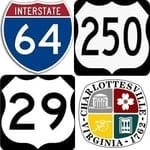
 Interstate 64, Route 29 and Route 250 carry drivers from other parts of Virginia and other states through the Charlottesville area. A person cited while traveling may live far from the assigned court. An out-of-state driver may contest a Virginia traffic charge. A conviction may be reported to the home state licensing authority, which determines how the Virginia disposition affects the driver’s record and driving privileges. An attorney may be able to request waiver of the client’s personal appearance in some traffic cases. Whether the court permits that request depends on the charge and individual circumstances. A driver should not miss court unless appearance requirements have been confirmed. The driver should preserve the complete summons, confirm whether the case is assigned to Charlottesville or Albemarle County and obtain a current home state driving record when appropriate.
Charlottesville Traffic Court Process
 Traffic cases arising within the City of Charlottesville are generally heard in Charlottesville General District Court. Charlottesville and Albemarle County are separate jurisdictions, and a charge arising outside the city limits may instead be assigned to Albemarle General District Court even when the driver associates the location with Charlottesville. The court printed on the summons should be confirmed before the scheduled hearing.
Charlottesville General District Court
606 East Market Street
Charlottesville, Virginia 22902
The process may involve:
- Issuance of a Virginia Uniform Summons
- Review of the exact charge
- Review of the driving record
- Determination of appearance requirements
- Collection of recordings and other evidence
- Discussions with the officer or prosecutor when appropriate
- Presentation of evidence at trial
- Legal objections and argument
- A finding and possible sentence or fine
- Possible appeal when authorized by law
What to Send for a Charlottesville Traffic Case Review
Complete documents and a clear account of the traffic stop can help identify the charge, evidence, court date and possible consequences.
Useful materials may include:
- The complete Virginia Uniform Summons
- The court date and assigned court
- A current driving record
- Prior traffic court documents
- License suspension or restriction documents
- Registration and insurance records
- Photographs and video recordings
- Witness names and contact information
- Roadway, traffic and weather information
- Vehicle and repair records
- Employment or licensing information
- A written account of the traffic stop
Charlottesville Traffic Lawyer FAQs
Where are Charlottesville traffic cases heard?
Traffic charges arising within the City of Charlottesville are generally heard in Charlottesville General District Court at 606 East Market Street. A charge arising outside the city may instead be assigned to an Albemarle County court.
Is signing a Virginia Uniform Summons an admission of guilt?
No. Signing a summons generally acknowledges receipt of the document and the obligation to appear or otherwise respond as required. It is not an admission that the alleged violation occurred.
Should I prepay a Charlottesville traffic ticket?
Prepayment ordinarily results in a conviction for the offense printed on the summons. The driver should understand the charge, DMV points, driving record consequences and any other effects before deciding whether to prepay.
Are all Charlottesville traffic charges ordinary infractions?
No. Some charges are ordinary traffic infractions, while others are misdemeanors or felonies. The exact Virginia Code section and charging language identify the nature of the allegation.
Can a traffic conviction affect my driving record?
Yes. A conviction may appear on the driving record, result in DMV demerit points and affect license status, insurance or employment depending on the charge and driving history.
What evidence may be relevant in a traffic case?
Evidence may include officer testimony, body camera recordings, dashboard camera recordings, witness statements, road signs, pavement markings, photographs, vehicle records, DMV records and statements attributed to the driver.
Can I be charged criminally for driving on a suspended license?
Potentially. The classification and consequences depend on the license status, reason for suspension, notice, prior record and exact statute charged.
Can a lawyer appear without me in Charlottesville traffic court?
An attorney may be able to request waiver of the client’s personal appearance in some cases. Whether the court permits that request depends on the charge and circumstances. A driver should not miss court unless the requirement has been confirmed.
Can an out-of-state driver contest a Charlottesville traffic charge?
Yes. An out-of-state driver may contest the Virginia charge. A conviction may be reported to the home state, which determines any additional effect on the driver’s record or license.
Can a Charlottesville traffic charge be reduced or dismissed?
A charge may be dismissed, amended, reduced or resolved in another manner depending on the statute, admissible evidence, driving record, prosecutorial decisions and court rulings. No particular outcome can be guaranteed.
What should I provide for a Charlottesville traffic case review?
Provide the complete summons, court information, driving record, license documents, photographs, recordings, witness information, vehicle records and a written account of the traffic stop.
Request a Confidential Charlottesville Traffic Case Review
 A traffic charge may affect the driving record, license status, insurance, employment and other important interests. Reviewing the exact charge, summons, evidence, driving history and possible consequences before court can help identify the issues requiring attention.
Request a confidential Charlottesville traffic case review.
9/20/2024 | Updated 8/5/2026