Roanoke VA Traffic Lawyer

Best Law Firm 2025 Riley & Wells Attorneys-at-Law Riley & Wells defends drivers charged with traffic offenses in Roanoke, Virginia, including reckless driving, speeding tickets, driving on a suspended license, hit and run, and other violations that may carry DMV points, license consequences, increased insurance costs, or mandatory court appearances. Our attorneys represent clients in cases arising from traffic stops on I-81, I-581, Route 220, Route 460, and other roads throughout Roanoke and the surrounding area. If you received a Virginia Uniform Summons, the first step is to identify the exact charge, the court handling the case, and whether your appearance is required.

Bad Things Can Happen To Good People.
Experienced attorneys. Case review available.
30,000+ Clients Represented  |  1,500+ Five-Star Reviews  |  60+ Years Combined Experience

Roanoke VA Traffic Defense Guide

Traffic Court Process Common Traffic Charges
I-81, I-581 & Local Roads Enforcement Agencies
Virginia Uniform Summons Out-of-State Drivers
Evidence & Defense Issues FAQ

For broader statewide guidance, see our Virginia Traffic Lawyer page.

Traffic Court in Roanoke VA

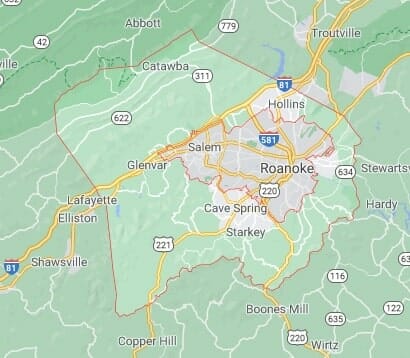
Traffic charges arising in the Roanoke area may be scheduled in Roanoke City General District Court or Roanoke County General District Court, depending on where the alleged offense occurred and the court identified on the Virginia Uniform Summons. The court listed on the summons controls where the driver must respond.

A Roanoke traffic case can involve much more than simply paying a fine. Some traffic infractions may be prepaid, while other charges require a court appearance or should be reviewed before any payment is made. A conviction may carry Virginia DMV demerit points, license consequences, increased insurance costs, employment problems, or misdemeanor criminal penalties depending on the allegation.

Before deciding how to proceed, review the exact charge, Virginia Code section, alleged location, court date, and appearance instructions printed on the summons. Paying a prepayable ticket generally resolves the case as a guilty disposition, so the possible consequences should be understood before payment is submitted.

Common Roanoke VA Traffic Charges

Drivers charged in Roanoke may face offenses ranging from ordinary moving violations to misdemeanor traffic allegations. Riley & Wells defends Roanoke traffic cases involving:

  • Speeding tickets
  • Reckless driving
  • Driving on a suspended license
  • Driving on a revoked license
  • No operator’s license
  • Failure to maintain insurance
  • Improper passing
  • Following too closely
  • Unsafe or improper lane changes
  • Failure to obey a highway sign
  • Failure to obey a traffic signal
  • Handheld mobile-device violations
  • Hit and run
  • Failure to stop after an accident
  • Commercial driver violations
  • Other traffic infractions and criminal traffic offenses

The legal and practical consequences depend on the specific offense. A routine traffic infraction is different from reckless driving, DUI, hit and run, or driving on a suspended license, which may be prosecuted as misdemeanor criminal offenses.

Roanoke VA Traffic Enforcement Corridors

Roanoke VA traffic lawyer for I-81 I-581 Route 220 and Route 460 traffic chargesTraffic enforcement around Roanoke is shaped by interstate travel, commuter traffic, downtown streets, arterial highways, entrance and exit ramps, and changing speed limits. Important enforcement corridors include Interstate 81, Interstate 581, Route 220, Route 460, Orange Avenue, Williamson Road, Franklin Road, Peters Creek Road, Electric Road, and roads connecting downtown Roanoke with the airport and surrounding communities.

Interstate 81 traffic enforcement affects local commuters, commercial drivers, college students, vacation travelers, and out-of-state motorists passing through western Virginia. Traffic stops may occur near interchanges, construction areas, work zones, speed transitions, and heavily traveled portions of the interstate.

Interstate 581 traffic enforcement can involve drivers traveling between I-81, downtown Roanoke, Route 220, Valley View, and the Roanoke-Blacksburg Regional Airport area. The location of the stop may affect which court handles the case and which law-enforcement agency issued the summons.

Location matters because road configuration, posted speed, direction of travel, traffic conditions, lane patterns, nearby ramps, officer position, construction activity, and the description written on the summons may all affect how the traffic charge should be evaluated.

Traffic Enforcement Agencies in Roanoke VA

Roanoke-area traffic summonses may be issued by different law-enforcement agencies depending on the location of the stop. Virginia State Police commonly patrol Interstate 81, Interstate 581, Route 220, Route 460, and other primary highway corridors. The Roanoke Police Department and Roanoke County Police Department enforce traffic laws within their respective jurisdictions.

The identity of the issuing agency does not by itself determine the outcome of a case, but it may help identify the patrol area, officer involved, speed-measurement method, available recordings, and type of evidence that may exist.

Depending on the charge, relevant evidence may include:

  • Officer observations
  • Radar evidence
  • Lidar evidence
  • Pacing evidence
  • Calibration records
  • Tuning fork records
  • Body-camera footage
  • In-car video
  • Witness statements
  • Accident reports
  • Road photographs
  • Traffic and weather conditions

Drivers should preserve the summons and write down what they remember about the location, traffic, weather, officer position, statements made during the stop, and any speed-measurement method discussed by the officer.

Virginia Uniform Summons for Roanoke Traffic Charges

A Virginia Uniform Summons is the charging document most drivers receive after a traffic stop. It generally identifies the alleged offense, Virginia Code section, court, hearing date, appearance instructions, officer, and location associated with the charge.

Signing the summons is generally not an admission of guilt. The signature ordinarily confirms the driver’s promise to appear or otherwise respond as directed. The summons should be reviewed carefully because important information may include:

  • The exact offense charged
  • The Virginia Code section
  • The speed alleged
  • The posted speed limit
  • The road or stop location
  • The court handling the case
  • The hearing date and time
  • The officer’s name and agency
  • Whether personal appearance is required
  • Whether the charge is listed as prepayable
  • Whether an accident is alleged
  • Whether the driver’s address is accurate

A driver should not assume that prepayment is the best option merely because the court permits it. Prepayment generally results in a conviction, and the effect on DMV points, insurance, employment, a commercial driver’s license, or an out-of-state license may not be apparent from the face of the summons.

Out-of-State Drivers Charged in Roanoke VA

Roanoke receives substantial through-traffic from drivers using Interstate 81, Interstate 581, Route 220, Route 460, and connecting western Virginia highways. An out-of-state driver who receives a Virginia traffic summons may have questions about returning to court, hiring local counsel, home-state reporting, insurance consequences, and the effect of a Virginia conviction on an out-of-state license.

Virginia determines how the charge is prosecuted in court, but the driver’s licensing state generally determines how a reported conviction affects the home-state driving record. The result may vary based on the offense and the laws of the licensing jurisdiction.

Out-of-state drivers should not assume that a Virginia traffic charge can be ignored or safely prepaid without reviewing the consequences. A traffic conviction may be reported to the home state and may affect insurance, license privileges, employment, or commercial driving status.

In some Roanoke traffic cases, an attorney may be able to appear without the driver personally returning to court. Whether that is possible depends on the charge, court, judge, accident facts, alleged speed, case posture, and appearance requirements. Serious misdemeanor allegations may require personal appearance.

Evidence and Defense Issues in Roanoke Traffic Cases

Every Roanoke traffic case should be evaluated based on the specific allegation, language of the summons, prosecution evidence, driving history, license status, and facts surrounding the traffic stop. A defense strategy is not the same in every case.

Depending on the charge, relevant defense and mitigation issues may include:

  • Whether the facts prove each element of the offense
  • The officer’s observations and location
  • Radar or lidar calibration
  • Tuning fork records
  • Pacing distance and conditions
  • Vehicle identification
  • Posted speed-limit signs
  • Road and lane configuration
  • Traffic volume
  • Weather and visibility
  • Construction or work-zone conditions
  • Statements attributed to the driver
  • Body-camera or dashboard-camera footage
  • Accident causation
  • Witness reliability
  • Driving record
  • Driver improvement course
  • Community service
  • Speedometer calibration
  • Out-of-state license consequences
  • Commercial driver concerns
  • Employment or insurance consequences

Some traffic cases may involve a legal or factual challenge to the evidence. Others may involve mitigation, negotiation, amendment to a lesser offense, or another appropriate resolution. The proper strategy depends on the charge, evidence, local court process, driving record, and consequences that matter to the client.

What to Send Before Roanoke Traffic Court

Helpful information can make a Roanoke traffic case review more productive. Send clear copies or photographs of the paperwork you received, along with any records, photographs, videos, or background information that may affect the defense strategy.

  • Virginia Uniform Summons
  • Court date and courthouse information
  • Statute number listed on the summons
  • Speed alleged and posted speed limit
  • Road name and stop location
  • Officer name and agency
  • Driving record
  • DMV transcript, if available
  • Speedometer calibration, if applicable
  • Driver improvement certificate
  • Community service records
  • Commercial driver’s license concerns
  • Insurance or employment concerns
  • Military or security-clearance concerns
  • Photographs or dash-camera video
  • Accident report or crash information
  • Witness names and contact information
  • Out-of-state license information

Roanoke VA Traffic Case Review

Our attorneys review the summons, statute number, court date, officer’s allegations, road location, alleged speed, driving record, DMV consequences, license status, accident facts, witness issues, out-of-state consequences, commercial driver concerns, and possible defenses.

We help clients understand whether they should challenge the charge, gather records, prepare mitigation, negotiate, request a reduction, prepare for trial, or take other steps before court.

Roanoke VA Traffic Lawyer FAQs

Do I have to go to court for a Roanoke traffic ticket?

That depends on the charge and the instructions on the summons. Some traffic infractions may be prepaid, while other offenses require a court appearance. Reckless driving, DUI, hit and run, driving on a suspended license, and other misdemeanor traffic charges should be reviewed carefully before court.

Where will my Roanoke traffic case be heard?

The court identified on the Virginia Uniform Summons controls where the case is scheduled. Depending on where the alleged offense occurred, the case may be assigned to Roanoke City General District Court, Roanoke County General District Court, or another court serving the location of the traffic stop.

What is a Virginia Uniform Summons?

A Virginia Uniform Summons is a charging document commonly issued during a traffic stop. It identifies the alleged offense, applicable statute, court date, court location, and instructions for responding to the charge.

Is signing a Virginia Uniform Summons an admission of guilt?

No. Signing the summons is generally a promise to appear or otherwise respond as directed. It is not the same as entering a guilty plea.

Can I prepay a Roanoke traffic ticket?

Some traffic infractions may be prepaid, but other charges are not prepayable. Prepayment generally results in a guilty disposition, so drivers should understand the possible DMV, insurance, licensing, employment, and out-of-state consequences before paying a ticket.

Can a Roanoke traffic conviction affect my driving record?

Yes. Depending on the offense, a conviction may result in Virginia DMV demerit points, a record entry, license consequences, or increased insurance costs. Misdemeanor traffic convictions may carry additional criminal and collateral consequences.

What is the difference between a traffic infraction and a misdemeanor?

A traffic infraction is generally punishable by a fine and administrative consequences rather than incarceration. A misdemeanor traffic offense is a criminal charge that may carry a fine, possible jail exposure, license consequences, and a criminal conviction. The classification depends on the specific Virginia statute charged.

What happens if I miss my Roanoke traffic court date?

The consequences depend on the charge and the court. The court may hear certain matters in the driver’s absence, issue additional process, or take other action. A driver who has missed court should promptly determine what occurred and what steps may still be available.

Can a lawyer appear for me if I live outside Virginia?

Possibly. Whether an attorney may appear without the driver depends on the charge, court, judge, alleged speed, accident facts, and case posture. The appearance requirement should be confirmed before deciding not to attend.

Will Virginia report a Roanoke traffic conviction to my home state?

A Virginia conviction may be reported to the state that issued the driver’s license. The home state then determines how the reported offense affects its own driving record, points, insurance, or license status.

Can a Roanoke traffic charge affect a commercial driver’s license?

Yes. Commercial drivers may face federal and state reporting requirements, employer consequences, and CDL disqualification issues depending on the offense. A CDL holder should evaluate both the court consequences and the separate commercial-license implications.

What should I send to a Roanoke VA traffic lawyer before court?

Helpful materials include the summons, court date, statute number, alleged speed, posted speed limit, road location, driving record, DMV transcript, accident report, photographs, dash-camera video, witness information, speedometer calibration, CDL concerns, and out-of-state license information.

Contact a Roanoke VA Traffic Lawyer

Virginia Super Lawyers 2025 Riley & Wells Attorneys-At-Law If you received a speeding ticket, reckless driving summons, suspended-license charge, hit-and-run allegation, commercial driver violation, or other traffic summons in Roanoke, Virginia, our attorneys can review the facts and help you understand the next step. We can help. Contact us for a confidential review of your Roanoke VA traffic case.

8/25/2021 | Updated 7/10/2026