
Speedometer Calibration for Virginia Speeding & Reckless Driving Cases
 A speedometer calibration, also called a speedometer verification test, measures the accuracy of a vehicle’s speedometer. In certain Virginia speeding and reckless driving cases, a properly performed calibration may provide useful evidence when a vehicle’s speedometer displays a speed different from the vehicle’s actual speed. Before having your speedometer tested, repaired, adjusted, or replaced, consult your attorney. A calibration is not appropriate or helpful in every case, and an improperly performed test or incomplete report may have little evidentiary value. Virginia law permits properly documented speedometer calibration evidence to be considered in court, but the results do not automatically establish a defense or guarantee a reduced charge.
Virginia Speedometer Calibration Information & Resources
What Is a Speedometer Calibration or Verification Test?
 A speedometer calibration is a specialized accuracy test that compares the speed displayed on a vehicle’s speedometer with the vehicle’s actual speed. The purpose is to determine whether the speedometer is accurate and, if it is not, how many miles per hour the displayed speed differs from the actual speed.
Continue Reading
A speedometer may display a speed that is higher or lower than the vehicle’s actual speed. Differences can result from several factors, including tire size, wheel size, mechanical problems, electronic components, or modifications to the vehicle.
A speedometer verification test measures this difference at various speeds. Testing facilities may use a chassis dynamometer, commonly called a “dyno,” or other appropriate specialized equipment to evaluate speedometer accuracy.
For example, a vehicle may actually be traveling 75 mph while its speedometer displays only 70 mph. In that situation, the speedometer is understating the vehicle’s actual speed by 5 mph.
The difference may be relevant when evaluating a Virginia speeding or reckless driving charge. However, the usefulness of the result depends on the allegations, the quality of the calibration evidence, and the defense strategy.
A speedometer calibration is an accuracy test. It is not an instruction to repair or adjust the vehicle.
Consult Your Attorney Before Having Your Speedometer Calibrated
Do not automatically schedule a speedometer calibration simply because you received a Virginia speeding ticket or reckless driving summons. Consult the attorney handling your case before deciding whether a test should be performed.
There are several reasons why an attorney may recommend a calibration in one case but advise against it in another. The attorney should consider the alleged speed, the offense charged, the available evidence, the vehicle involved, and how the calibration results might affect the defense.
A calibration showing that the speedometer was inaccurate may be useful in some cases. A test showing that the speedometer was accurate, or that it displayed a higher speed than the vehicle’s actual speed, may not support the defense position the defendant anticipated.
A calibration also involves an expense that may be unnecessary if the attorney does not believe the results would materially assist in presenting the case.
What Should You Do Before Scheduling a Test?
- Contact your attorney. Discuss the alleged speed, the charge, and whether a speedometer calibration is recommended.
- Identify a qualified testing facility. If testing is recommended, locate a technician or business that performs specialized speedometer accuracy testing and prepares court-related documentation.
- Confirm the report requirements. Make sure the testing facility can provide a properly sworn calibration report suitable for use in a Virginia court proceeding.
- Preserve the vehicle’s existing condition. Do not repair, adjust, or replace the speedometer, change tire or wheel sizes, or make other modifications affecting speedometer accuracy before discussing those changes with your attorney.
- Provide the completed report to your attorney. The attorney should review the test results before deciding whether and how to present the report in court.
The important point is that speedometer calibration is a potential source of legal evidence, not merely routine automotive maintenance.
Where Can You Get a Proper Speedometer Calibration?
 A proper speedometer calibration or speedometer verification test generally requires a technician who specializes in measuring vehicle speedometer accuracy and has access to appropriate testing equipment. An ordinary oil-change business, general automotive repair shop, or automobile dealership should not be assumed to offer the specialized testing and sworn documentation needed for a Virginia court case.
Continue Reading
Most businesses that change oil, rotate tires, perform routine vehicle inspections, or service automobile engines are not equipped to conduct the type of speedometer verification testing commonly used in Virginia speeding and reckless driving cases.
Likewise, an automobile dealership may have technicians who can diagnose or repair a vehicle’s speedometer without providing the particular accuracy test and sworn report needed for court.
Technicians who specialize in speedometer calibration generally perform accuracy testing rather than speedometer repairs.
The testing facility should be able to:
- Test the speedometer at multiple speed intervals.
- Measure and record actual speed compared with displayed speed.
- Identify the amount and direction of any speedometer error.
- Identify the vehicle being tested.
- Provide a written report documenting the test results.
- Prepare a properly sworn report suitable for presentation in a Virginia court.
Virginia Code § 46.2-942 does not require one particular professional license or testing-equipment brand. What matters is that the test is reliable and the resulting report satisfies the applicable evidentiary requirements.
Before selecting a testing facility, consult your attorney about what type of report is needed and whether the proposed facility can provide it.
Can Out-of-State Drivers Get Their Speedometers Calibrated Near Home?
Many people charged with speeding or reckless driving in Virginia live in Maryland, Pennsylvania, New Jersey, North Carolina, Florida, or another state. Others reside in Virginia but are charged in a county or city far from their homes.
A defendant ordinarily does not have to return to the Virginia jurisdiction where the traffic offense allegedly occurred simply to have the vehicle’s speedometer tested.
If the attorney recommends a calibration, an out-of-state defendant may arrange for testing through a qualified speedometer verification technician near home, provided the facility can perform the appropriate test and furnish the necessary sworn documentation.
The important issue is not where the speedometer is tested, but whether the testing and documentation satisfy the applicable Virginia evidentiary requirements.
Before arranging an out-of-state test, ask your attorney to review the proposed testing facility’s documentation procedures. A report prepared by an out-of-state technician should not be assumed acceptable merely because the business advertises speedometer calibration services.
If the attorney recommends testing, the defendant should ordinarily have the same vehicle tested in its existing condition without first making modifications that could affect speedometer accuracy.
Speedometer Calibration Is a Test, Not a Speedometer Repair
 One of the most common misunderstandings about speedometer calibration evidence is the belief that having a speedometer repaired or replaced is the same thing as having it tested for accuracy. A speedometer repair invoice or work order is not a substitute for a properly performed speedometer calibration or verification test.
Continue Reading
A repair shop may diagnose a malfunction, replace an instrument cluster, adjust electronic components, or repair a defective speedometer. A work order documenting those services ordinarily does not establish how accurately the speedometer was displaying the vehicle’s speed before the work was performed.
For purposes of a Virginia speeding or reckless driving case, the relevant questions may include:
- Was the speedometer inaccurate?
- Was it displaying a speed higher or lower than the vehicle’s actual speed?
- How many miles per hour was the speedometer inaccurate?
- At what speeds did the inaccuracy occur?
- Does the testing provide reliable evidence relevant to the vehicle’s condition on the date of the alleged offense?
A repair invoice stating that a speedometer was fixed or replaced generally does not answer these questions.
Have the Speedometer Tested Before Making Repairs
If your attorney recommends a speedometer calibration, the accuracy test should generally be performed before the speedometer is repaired, adjusted, or replaced.
Once the speedometer is repaired, its original condition may no longer be available for testing. This could prevent the defendant from obtaining reliable documentation of the speedometer’s previous inaccuracy.
After the testing has been completed and the proper sworn calibration report has been obtained, a defendant may choose to have the speedometer repaired or replaced. The repair should not be confused with the earlier calibration test.
Most technicians who specialize in speedometer accuracy testing do not perform speedometer repairs themselves.
What If the Speedometer Has Already Been Repaired?
If the speedometer was repaired or replaced before an accuracy test was performed, tell your attorney exactly what work was completed and when.
Preserve any repair invoices, diagnostic reports, or other available records. These documents may provide background information, but they ordinarily do not replace a test documenting the speedometer’s actual accuracy before the repair.
A calibration performed after the alleged offense also does not automatically prove the speedometer’s exact condition on that earlier date. The timing of the test, vehicle condition, and any intervening repairs or modifications can affect the evidentiary value of the report.
Sample Speedometer Calibration Report for Virginia Court
The following is an example of an actual speedometer calibration report. It illustrates the type of documentation a qualified testing facility may prepare after performing a speedometer accuracy test.
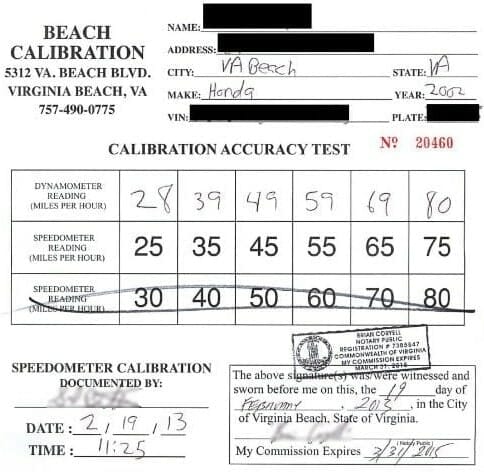
Sample speedometer calibration certificate for illustrative purposes. The actual report required in a particular case should be reviewed by the defendant’s attorney.
Understanding the Speedometer Calibration Results
A proper calibration report ordinarily identifies the vehicle and records the test results at several speeds. The report should distinguish between the vehicle’s actual speed during testing and the speed displayed on its speedometer.
For example, consider the following hypothetical test results:
| Actual Vehicle Speed | Speedometer Display | Difference |
|---|---|---|
| 40 mph | 37 mph | 3 mph low |
| 60 mph | 56 mph | 4 mph low |
| 80 mph | 75 mph | 5 mph low |
Illustrative figures only; these are not representations of the results shown in the sample certificate above.
In this example, the speedometer understates the actual vehicle speed. A driver relying on the speedometer might believe the vehicle was traveling 75 mph when it was actually traveling 80 mph.
Other speedometers may display speeds that are higher than the vehicle’s actual speed. An accurate calibration measures the difference regardless of whether the result is favorable or unfavorable to the defendant.
What Must the Written Calibration Report Contain?
A useful speedometer calibration report should ordinarily contain:
- The identity of the vehicle tested, including identifying information such as the VIN.
- The date the calibration test was performed.
- The actual speed and displayed speed at the tested intervals.
- The identity of the technician or testing facility.
- The technician’s signed certification of the results.
- A proper sworn statement or jurat establishing that the report was made under oath or affirmation.
The statutory requirement is a sworn report. A notary’s ordinary acknowledgment of a signature is not necessarily the same as an oath or affirmation. The specific report and its execution should be reviewed by the attorney before trial.
A report does not necessarily have to duplicate the exact appearance of the sample above. What matters is that it reliably documents the test and satisfies the applicable legal requirements.
Speedometer Calibration Evidence Under Virginia Law
 Virginia law specifically addresses the admissibility of sworn speedometer calibration reports in cases involving alleged violations of maximum speed limits. Under Virginia Code § 46.2-942, the court must receive a qualifying sworn calibration report as evidence and consider it when determining guilt or innocence and fixing punishment.
Continue Reading
The statute applies to a calibration test of the accuracy of the speedometer in the vehicle operated by the defendant or the arresting officer at the time of the alleged offense.
The law permits a qualifying sworn report to be received without requiring the technician to appear merely to present the test results. However, that does not necessarily prevent additional challenges concerning the report, the testing procedure, or the evidence.
The court must consider the calibration evidence, but the law does not require the judge to give the report any particular weight or reach a specific result.
Does an Inaccurate Speedometer Provide a Legal Defense?
An inaccurate speedometer does not automatically establish a defense to a Virginia speeding charge.
In Williams v. Commonwealth, 5 Va. App. 514 (1988), the Virginia Court of Appeals held that a defective speedometer does not create an absolute defense to speeding. The court also explained that the fact finder determines how much weight to give the calibration evidence based on the circumstances of the case.
The distinction is important. The calibration may explain why a driver believed the vehicle was traveling at one speed when it was actually traveling faster, but that belief does not necessarily establish that the vehicle was traveling within the lawful speed limit.
How Can a Calibration Help in a Reckless Driving Case?
In a Virginia reckless driving case based on speed, a properly documented speedometer error may be relevant to the overall defense and the degree of culpability.
For example, calibration results showing that the speedometer substantially understated the vehicle’s actual speed may help explain the driver’s perception of speed. This evidence can be considered along with the charged speed, driving conditions, prior record, and other relevant circumstances.
Under Virginia Code § 46.2-869, a court or jury may find a defendant charged with reckless driving not guilty of reckless driving but guilty of improper driving when the degree of culpability is slight. A Commonwealth’s Attorney may also reduce a reckless driving charge to improper driving before the court’s decision.
Speedometer calibration evidence may be relevant to those considerations, but a calibration does not automatically establish slight culpability or require a reduction to improper driving.
Does the Date of the Calibration Matter?
The date of the test may affect the weight given to the evidence. A calibration performed relatively close to the alleged offense may present different evidentiary considerations than one performed months later, particularly if the vehicle’s tires, wheels, speedometer components, or other relevant equipment have changed.
The attorney should also determine whether the original signed report or another properly authenticated version should be presented in court.
Defective Equipment in Virginia Is a No-Points, Non-Moving Violation
 A properly documented speedometer inaccuracy may sometimes help an attorney obtain a disposition involving defective equipment rather than the original speeding or reckless driving allegation. A conviction for an applicable defective equipment offense is generally classified as a non-moving violation without Virginia DMV demerit points, unlike a speeding or reckless driving conviction.
Continue Reading
Virginia law contains several provisions addressing vehicle equipment, including defective speedometers.
Virginia Code § 46.2-1080 specifically addresses the use of a speedometer that is not in good working order.
Virginia Code § 46.2-1003 separately addresses certain defective and unsafe vehicle equipment. The two statutes are not interchangeable, and the appropriate equipment offense depends on the facts and applicable law.
Can a Speeding or Reckless Driving Charge Be Reduced to Defective Equipment?
In some cases, an attorney may use a sworn calibration report, together with other circumstances, to seek a reduction of a speeding or reckless driving allegation to an appropriate equipment violation.
Such a disposition can be important because a defective equipment offense generally does not carry the same criminal classification or DMV demerit points as reckless driving or many speeding offenses.
However, a reduction is not automatic. A calibration report does not entitle a defendant to a defective equipment conviction, and the prosecutor or judge must agree to or make a legally appropriate disposition.
Why Proper Testing and Documentation Matter
If the defense intends to rely on speedometer inaccuracy, the ability to establish the amount and direction of the error may be important.
A repair invoice stating that a speedometer was replaced is not equivalent to a sworn report showing the speedometer’s accuracy before repairs.
An attorney can evaluate whether the documented error, the offense charged, and the other facts support requesting a lesser offense, including defective equipment or improper driving where legally appropriate.
Frequently Asked Questions About Speedometer Calibration in Virginia
Drivers charged with speeding or reckless driving in Virginia often have questions about where to obtain a speedometer calibration, whether a test can help their case, and what documentation must be presented in court. The answers depend on the particular charge, the vehicle, the testing results, and the circumstances of the case. The FAQs below address common questions about speedometer accuracy testing and its use in Virginia traffic cases.
Should I get my speedometer calibrated before consulting my Virginia traffic attorney?
No. Consult your attorney before scheduling a speedometer calibration or verification test. A calibration may not be necessary or helpful in every case, and the attorney should evaluate the potential benefits, disadvantages, testing requirements, and defense strategy before recommending that the vehicle be tested.
Can an automobile dealership or regular mechanic perform a speedometer calibration for court?
Do not assume that a dealership, oil-change business, or ordinary automotive repair shop performs the specialized speedometer accuracy testing needed for a Virginia court case. A proper test generally requires specialized equipment and a technician who can prepare a sworn report documenting the actual speed, displayed speed, and amount of any error. Consult your attorney before choosing a testing facility.
Can I get my speedometer calibrated outside Virginia?
Yes. An out-of-state defendant may ordinarily have a speedometer tested by an appropriate specialized technician near home rather than returning to the Virginia county or city where the charge is pending. The testing facility must be able to provide the necessary sworn calibration documentation. Discuss the proposed testing facility and report requirements with your attorney before scheduling the test.
Should I repair my speedometer before having it calibrated?
No. If your attorney recommends a calibration, the speedometer should generally be tested in its existing condition before repairs, adjustments, or replacement. Repairing the speedometer first may eliminate the opportunity to document its original inaccuracy. Once the test has been completed and the proper sworn report obtained, repairs can be arranged as appropriate.
Can I use a speedometer repair receipt instead of a calibration report?
No. A repair invoice or work order ordinarily does not establish the accuracy of the speedometer before the repair or document the amount and direction of any error. A proper speedometer calibration report records the results of an accuracy test and provides the documentation needed for the attorney to evaluate its potential use as evidence in court.
Will a speedometer calibration get my Virginia reckless driving or speeding charge reduced?
Not necessarily. A properly sworn calibration report must be considered under Virginia Code § 46.2-942 when applicable, but an inaccurate speedometer does not automatically establish a defense or require a reduced charge. Depending on the circumstances, calibration evidence may assist an attorney in seeking a reduction to speeding, improper driving, or an appropriate defective equipment offense. The outcome depends on the evidence, applicable law, and the decisions of the prosecutor or court.
Questions About Speedometer Calibration for Your Virginia Case?
 Our attorneys represent drivers charged with speeding and reckless driving throughout Virginia, including motorists who live outside the Commonwealth. Our attorneys can evaluate whether a speedometer calibration may be helpful, explain the testing and documentation requirements, and determine how the evidence may be used in court. If you are an existing client, consult your attorney before scheduling a speedometer calibration or having your speedometer repaired. If you need representation for a Virginia speeding or reckless driving charge, our lawyers can review your case and discuss your defense options. Request a Confidential Virginia Case Review
2/16/2022 | Updated 11/8/2026