
Virginia Reckless Driving Lawyer
 Riley & Wells Attorneys-At-Law provides statewide defense for drivers charged with reckless driving in courts throughout Virginia. Our attorneys have more than 60 years of combined criminal and traffic-defense experience, and the firm has received more than 1,500 client reviews. We represent Virginia residents, out-of-state drivers, commercial drivers, and others charged with reckless driving by speed, accident-related reckless driving, improper control, racing, passing a stopped school bus, move-over violations, and other offenses. Virginia reckless driving is generally a Class 1 misdemeanor rather than a simple traffic infraction. A conviction may result in jail, a substantial fine, license suspension, DMV demerit points, increased insurance costs, employment consequences, and a criminal record. We review the summons, court, alleged speed or driving behavior, officer evidence, accident facts, speed-measurement evidence, driving record, and possible defenses or reductions. Early review can help identify evidence that should be preserved and practical steps that may improve the client’s position before court.







Virginia Reckless Driving Defense Guide
| Cases We Handle | Penalties |
| Reckless Driving by Speed | Accident Cases |
| Improper Driving | Defense Issues |
| Out-of-State Drivers | Statewide Court Coverage |
| Reckless Driving Guides | Frequently Asked Questions |
Virginia Reckless Driving Cases We Handle
Virginia has numerous reckless driving statutes addressing excessive speed, dangerous driving, vehicle control, passing, racing, exhibition driving, school buses, stationary emergency vehicles, and other conduct. Our attorneys represent clients charged under these laws in courts throughout the Commonwealth.
The exact code section listed on the Virginia Uniform Summons matters. Different reckless driving offenses have different elements, evidence, defenses, and possible license consequences.
Reckless Driving by Speed
Virginia Code § 46.2-862 applies when the Commonwealth alleges that a motorist drove at least 20 miles per hour above the applicable speed limit or at a speed exceeding 85 miles per hour regardless of the posted limit. These cases may involve RADAR, LIDAR, pacing, speedometer calibration, identification, location, signage, and mitigation evidence.
General and Accident Reckless Driving
Virginia Code § 46.2-852 prohibits driving recklessly or at a speed or in a manner that endangers life, limb, or property. Accident cases may involve disputed driving behavior, witnesses, photographs, body camera footage, vehicle data, road conditions, mechanical issues, and whether the evidence proves how the accident occurred.
Improper Control or Faulty Brakes
Virginia Code § 46.2-853 applies to driving a vehicle that is not under proper control or that has inadequate or improperly adjusted brakes. The mere occurrence of a loss of control or collision does not eliminate the Commonwealth’s burden to prove the charge. Mechanical records, vehicle condition, roadway evidence, weather, and witness testimony may be important.
Move Over Reckless Driving
Virginia’s stationary vehicle law requires drivers to change lanes when reasonable and safe or otherwise proceed with due caution at a safe speed when approaching certain vehicles displaying warning lights. The exact subsection matters because some violations are classified as reckless driving while others are traffic infractions. Review our Virginia Move Over Reckless Driving guide.
Passing a Stopped School Bus
Virginia Code § 46.2-859 generally requires a driver approaching a qualifying stopped school bus to stop and remain stopped while passengers are being taken on or discharged. Issues may include whether the vehicle legally qualified as a school bus, whether the required warning device was activated, roadway separation, direction of travel, identification, and whether a statutory exception applies.
Racing and Exhibition Driving
Virginia law treats racing and exhibition driving as forms of reckless driving. Exhibition driving can include specified intentional conduct such as burnouts, unnecessary spinning or zigzagging near a group of people, drag racing, or transporting a passenger on a vehicle’s hood or roof. These allegations may involve additional license consequences, vehicle impoundment, or felony charges when serious injury or death is alleged.
Other Virginia Reckless Driving Offenses
Other reckless driving statutes address passing on a curve or crest of a grade, an obstructed view, passing vehicles abreast, driving two vehicles abreast in one lane, passing at a railroad crossing, failing to give a proper signal, driving too fast for conditions, failure to yield, and dangerous driving on certain parking lots or other property open to the public.
Virginia Reckless Driving Penalties
Most Virginia reckless driving offenses are Class 1 misdemeanors. The maximum authorized punishment for a Class 1 misdemeanor is 12 months in jail, a fine of up to $2,500, or both. A conviction can also result in court costs, a criminal conviction record, DMV demerit points, insurance consequences, employment concerns, and possible loss of driving privileges.
| Offense classification | Generally a Class 1 misdemeanor |
| Maximum jail sentence | Up to 12 months |
| Maximum fine | Up to $2,500 |
| Driver’s license consequence | Court suspension may apply depending on the statute and circumstances |
| Virginia DMV consequence | Many common reckless driving offenses carry six demerit points and remain on the driving record for 11 years |
| Other possible effects | Insurance, employment, security clearance, professional licensing, and commercial driving concerns |
The maximum punishment is not imposed in every case. The actual risk depends on the code section, alleged speed or conduct, driving record, court, accident or injury allegations, license status, and other aggravating or mitigating facts.
Virginia courts may suspend driving privileges after a reckless driving conviction. The applicable range depends on the statute. For reckless driving charged under Virginia Code §§ 46.2-853 through 46.2-864, the court may impose a suspension of 60 days to six months. Racing, exhibition driving, and cases involving injury or death have separate provisions.
For a broader explanation, review the Virginia Reckless Driving Penalties guide.
Can a Reckless Driving Conviction Increase Car Insurance Premiums?
A reckless driving conviction can result in significantly higher automobile insurance premiums for several years. These additional expenses may substantially exceed the fine and court costs imposed by the judge. The financial impact depends on the insurance company, driving history, state of residence, and other factors.
Our article, Will a Virginia Traffic Ticket Increase My Car Insurance Premiums?, examines insurance rate increases following reckless driving and other traffic convictions, including the potential costs over several years.
Reckless Driving by Speed in Virginia
 Reckless driving by speed is one of the most frequently charged forms of reckless driving in Virginia. Virginia Code § 46.2-862 applies when the Commonwealth alleges that a motorist exceeded one of the two statutory speed thresholds. A summons is an accusation, not a conviction. Cases based on speed may involve the officer’s method of measurement, RADAR or LIDAR operation, pacing, location, identification of the vehicle, speed limit signs, equipment records, the driver’s speedometer, and evidence presented in mitigation.
Under Virginia Code § 46.2-862, a motorist may be charged with reckless driving for:
- Driving at least 20 miles per hour above the applicable maximum speed limit; or
- Driving at any speed exceeding 85 miles per hour, regardless of the applicable speed limit.
Because the statute uses both tests, a driver can face criminal reckless driving without being 20 miles per hour above the limit. For example, driving 86 mph in a 70 mph zone exceeds 85 mph and falls within the statute even though it is 16 mph above the posted limit.
For specific information about the charge, review the Virginia Code § 46.2-862 guide and the page addressing reckless driving over 85 mph.
Virginia Reckless Driving Accident Cases
An accident can result in a reckless driving charge under the general reckless driving statute, improper control statute, or another provision. The mere occurrence of a collision does not by itself establish every element of reckless driving. The Commonwealth must present sufficient admissible evidence proving the charged offense beyond a reasonable doubt.
Accident cases may require review of:
- How the collision occurred;
- Statements made by drivers and witnesses;
- Body camera, dash camera, surveillance, and cellphone video;
- Photographs, measurements, skid marks, and vehicle damage;
- Traffic signals, lanes, signs, roadway design, and visibility;
- Weather, lighting, road surface, and construction conditions;
- Mechanical failure, brakes, tires, or other vehicle issues;
- Electronic vehicle data and accident reconstruction; and
- Whether another vehicle, person, or event contributed to the accident.
Cases involving serious injury or death require especially careful review because they may carry increased license consequences or separate felony exposure depending on the precise allegation.
Can Reckless Driving Be Reduced to Improper Driving?
Virginia Code § 46.2-869 permits a court or jury to find a person charged with reckless driving not guilty of reckless driving but guilty of improper driving when the degree of culpability is slight. A Commonwealth’s Attorney may also reduce a reckless driving charge to improper driving before the court reaches its decision.
Improper driving is a traffic infraction rather than a criminal misdemeanor. It carries a maximum fine of $500. Whether improper driving is a realistic outcome depends on the evidence, the degree of culpability, the driving record, the jurisdiction, the position of the prosecution, and other circumstances.
A reduction is not automatic merely because the driver has a good record or completes a driving course. Preparation should be based on the specific charge and the practices of the court handling the case.
Defense Issues We Review in Virginia Reckless Driving Cases
Every reckless driving case is different. Our attorneys review the summons, code section, court, officer evidence, driving record, alleged conduct, and the client’s practical concerns. The issues that matter depend on whether the case involves speed, an accident, vehicle control, passing, racing, exhibition driving, or another allegation.
Speed Measurement and Identification Evidence
Cases based on speed may require review of the measurement method, operator testimony, equipment records, testing requirements, pacing distance, speedometer calibration, location, traffic conditions, identification of the vehicle, and whether the Commonwealth can prove the alleged speed.
Accident, Witness, and Video Evidence
Accident cases may depend on witness credibility, statements, photographs, physical evidence, video, road conditions, vehicle data, mechanical issues, accident reconstruction, and whether the evidence proves the driving behavior alleged in the summons.
Prior Record and Mitigation
The driver’s Virginia and out-of-state record, alleged speed, reason for travel, employment, commercial driver’s license status, driving course, speedometer calibration, community service, and other mitigation may affect how the case is presented. A driver should obtain advice before assuming that a particular mitigation step will help in the court handling the charge.
Legal Classification and Possible Reduction
The review may include whether the conduct satisfies the particular reckless driving statute, whether the evidence supports a traffic infraction disposition, whether improper driving applies, and whether the Commonwealth can prove every required element beyond a reasonable doubt.
What to Do After Receiving a Virginia Reckless Driving Summons
A Virginia Uniform Summons provides notice of the charge, court, and hearing date. Signing the summons is generally not an admission of guilt, but the document should be taken seriously because reckless driving is ordinarily a criminal charge rather than a prepayable traffic infraction.
- Save the summons: Keep the original document and make a readable copy or photograph.
- Confirm the code section: Determine whether the charge involves speed, general reckless driving, improper control, racing, a school bus, move over, or another statute.
- Preserve evidence: Save photographs, video, GPS data, dash camera recordings, repair records, medical information, witness details, and other relevant materials.
- Obtain the driving record: The prior driving history may affect preparation and possible outcomes.
- Do not assume the appearance is waived: Confirm what the court requires before deciding not to appear.
- Request a case review: Early review can help identify the evidence, risk, and practical steps appropriate for the particular court.
Out-of-State Drivers Charged With Reckless Driving in Virginia
Many Virginia reckless driving defendants live in another state and were charged while traveling through the Commonwealth. A Virginia conviction is generally reported through interstate driver record systems and may result in consequences imposed by the driver’s home state in addition to the Virginia court’s sentence.
A reckless driving summons ordinarily requires court attention. Depending on the jurisdiction, charge, alleged speed, record, and other facts, an attorney may be able to request that a nonresident’s personal appearance be waived. A waiver is discretionary and should never be assumed before the court approves it.
Out-of-state drivers should consider the Virginia charge, treatment of the license by the home state, insurance, employment, commercial driving status, travel requirements, and completion of any conditions ordered by the court. Review the Virginia Reckless Driving Guide for Out-of-State Drivers.
Virginia Reckless Driving Defense in Courts Across the Commonwealth
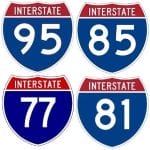 Our attorneys represent reckless driving clients in General District Courts and Circuit Courts throughout Virginia. We handle cases arising on I-95, I-81, I-64, I-77, I-66, I-295, I-495, U.S. highways, state routes, local roads, and other highways across the Commonwealth. The court matters. Procedures, prosecutors, judges, law enforcement agencies, scheduling practices, appearance requirements, and customary preparation can vary by jurisdiction. A strategy appropriate in one Virginia court may not be the best approach in another.
Explore Virginia courts and locations we serve
Why Clients Hire Our Lawyers for Reckless Driving Defense
Our attorneys have more than 60 years of combined criminal and traffic defense experience and regularly represent clients charged with reckless driving in Virginia courts. The firm has received more than 1,500 client reviews and has earned professional recognitions that include Best Law Firm, AV Preeminent, Super Lawyers, Avvo 10.0 Superb, and Virginia Business Legal Elite.
We begin by reviewing the summons, code section, court, alleged speed or conduct, police evidence, driving history, and what is most important to the client. The objective is to identify legal and factual issues, determine what preparation may help, and develop a strategy suited to the particular charge and jurisdiction.
Some cases should be challenged at trial. Others may be resolved through negotiation, amendment, reduction, or mitigation. The appropriate approach depends on the evidence and circumstances rather than a standard formula.
Thinking About Representing Yourself in Reckless Driving Court?
Some drivers consider handling their reckless driving case without an attorney to avoid paying legal fees. However, reckless driving is a criminal offense in Virginia, and representing yourself can expose you to serious legal and financial consequences. Our article, Do I Need a Lawyer for Reckless Driving in Virginia?, explains the risks of self-representation, including potential incarceration, courtroom challenges, insurance costs, and the expense of multiple court appearances.
Virginia Reckless Driving Guides
For neutral educational information about Virginia reckless driving laws, penalties, excessive speed, summonses, move over charges, and out-of-state driver issues, use the guides below. A person with a pending court date should still obtain a review of the specific charge and evidence.
Can an Old Reckless Driving Conviction Be Sealed?
Virginia’s record sealing law may allow some older reckless driving convictions to be sealed when the statutory eligibility requirements are satisfied. This can include certain reckless driving convictions that resulted from a DUI charge being reduced or amended. Learn more in our guide to Virginia Reckless Driving Record Sealing.
Virginia Defense Services
- Virginia Criminal Defense Lawyer
- Virginia Traffic Lawyer
- Virginia Speeding Ticket Lawyer
- Virginia DUI / DWI Lawyer
Virginia Reckless Driving Lawyer FAQs
Is reckless driving a criminal offense in Virginia?
Yes. Most Virginia reckless driving offenses are Class 1 misdemeanors rather than ordinary traffic infractions. A conviction can result in jail, a fine, possible license suspension, DMV consequences, and a criminal conviction record.
What speed is reckless driving in Virginia?
Virginia Code § 46.2-862 applies when a driver is accused of traveling at least 20 miles per hour above the applicable maximum speed limit or at a speed exceeding 85 miles per hour regardless of the posted limit.
Can I go to jail for reckless driving?
Yes. Because ordinary reckless driving is a Class 1 misdemeanor, the maximum authorized jail sentence is 12 months. Jail is not imposed in every case. The actual risk depends on the alleged conduct or speed, driving record, court, accident or injury allegations, license status, and other facts.
Can the court suspend my driver’s license?
Yes. A Virginia court may suspend driving privileges after a reckless driving conviction. The applicable range depends on the precise statute. Many reckless driving provisions allow a suspension of up to six months, while racing and certain offenses involving injury or death have separate rules.
Can I prepay a Virginia reckless driving summons?
Reckless driving is generally not a prepayable traffic infraction. It is ordinarily a criminal charge requiring court attention. Review the code section, court date, and appearance requirements before taking action.
Do I have to appear in court?
A reckless driving summons ordinarily requires a court appearance unless the court permits the defendant’s appearance to be waived. Whether a waiver may be requested depends on the jurisdiction, charge, alleged speed or conduct, record, and other circumstances. Do not assume that representation automatically excuses an appearance.
Does an accident automatically prove reckless driving?
No. The occurrence of an accident does not automatically prove every element of reckless driving. The Commonwealth still must present sufficient evidence establishing the charged offense beyond a reasonable doubt.
Can reckless driving be reduced to improper driving?
Potentially. A court or jury may find improper driving when the degree of culpability is slight, and a Commonwealth’s Attorney may reduce the charge before the court’s decision. Improper driving is a traffic infraction carrying a maximum fine of $500. A reduction is discretionary and depends on the evidence and circumstances.
What is exhibition driving in Virginia?
Exhibition driving includes specified intentional conduct near a group of people, such as burnouts, unnecessary spinning or zigzagging, displaying a vehicle’s speed or power through drag racing, or transporting a passenger on the hood or roof. Exhibition driving can be prosecuted as reckless driving and may involve license suspension and vehicle impoundment.
Can a Virginia reckless driving conviction affect an out-of-state license?
Yes. Virginia generally reports the conviction, and the licensing state may apply its own rules concerning points, suspension, insurance, or other consequences. The effect depends on the home state and the exact Virginia disposition.
What should I bring to a reckless driving case review?
Bring the summons, court date, driving record, alleged speed or code section, photographs, video, witness information, accident documents, vehicle repair records, speedometer calibration information, commercial driver’s license information, and any other material related to the stop or incident.
How much does a Virginia reckless driving lawyer cost?
Legal fees depend on the court, charge, alleged speed or conduct, driving record, accident or injury allegations, expected appearances, and complexity. After reviewing the summons and relevant facts, the firm can explain the proposed representation and fee arrangement.
Virginia Reckless Driving Case Review & Contact
If you have been charged with reckless driving in Virginia, early review can help you understand the criminal charge, court date, evidence, possible penalties, and practical steps that may be appropriate before court. Our attorneys represent clients throughout Virginia and can review the summons, exact code section, alleged speed or driving behavior, officer evidence, driving record, accident circumstances, appearance requirements, and possible defenses or reductions. When you contact us, please include the court date, exact charge, alleged speed if applicable, licensing state, and a copy or photograph of the summons. Request a Virginia reckless driving case review.
11/10/2015 | Updated 10/23/2026